
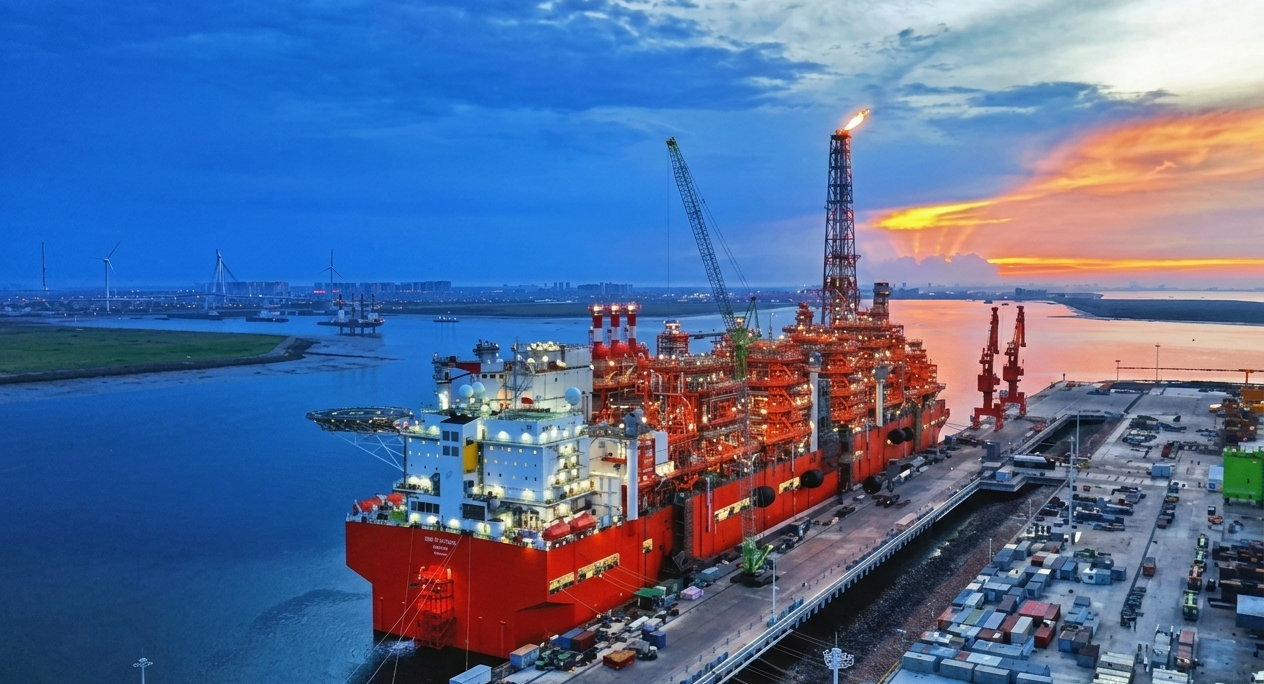
The objective of this newsletter is to discuss the options available to decarbonise a large FLNG vessel. This is the second paper in the Decarbonisation series, following our January 2022 newsletter which discussed similar options for a large FPSO. Since the two newsletters target different audiences, Part 2 is written as a stand-alone document. Readers of both will therefore notice some overlap, which is intentional and shows the synergy between the two products. A glossary of terms is included in section 8. Typical FLNG vessels, like the new Coral Sul FLNG below, have multiple sources of environmental emissions. Technology exists to significantly reduce these emissions, and pressure is now mounting to do so for several reasons.
Firstly, there is Environmental, Social, and Governance (ESG) pressure from stakeholders to reduce the environmental impact – both from internal stakeholders (staff) and external stakeholders (host governments, shareholders, media, and the public). Secondly, Financial Institutions are becoming more selective in the projects they finance (due to their own ESG pressure) and are likely to favour those which can show low carbon footprints. Thirdly, the application of a Carbon Tax, either imposed externally by local authorities or internally as a project sanction test, will also drive projects towards lower emissions. For all these reasons, the various technologies to reduce emissions are growing in importance, and we expect these to be widely applied soon.
Baseline
To help illustrate the potential to decarbonise, we have calculated the baseline emissions from a typical FLNG. We selected a generic design of 3.0 MTPA capacity using SMR technology and 3% CO2 in the feed gas as a Reference Case, and we have illustrated the main sources of emissions from this type of unit in Figure 1 (see page 7). We have then calculated the total CO2 equivalent emissions for this Reference Case FLNG, using GWP to convert hydrocarbon emissions back to CO2e, and applied vendor data for fuel demand. We found total CO2 equivalent emissions are around 1.30 MTPA at full capacity, which is broken down as shown in Figure 2 below.
Download the full newsletter here: February 2022 Newsletter.pdf